DeReset The pragmatic reset.

A DeReset guide by Ellery

Why You're Home but Still at Work

The Clock-Out Sequence: Simple Nervous System Regulation for the End of the Workday

Get The Clock-Out Sequence ($27)

Guide + 3 printable tools + bonus · $27 · 30-day money-back guarantee

A man in a work shirt stands in his kitchen at dusk beside a laptop he has just closed, rubbing the back of his neck, shoulders tense.

The moment you know

You closed the laptop an hour ago, or you walked in the door. Either way, you're done for the day.

Except you're not. You're still replaying that call, drafting the email you'll send tomorrow. Your jaw is tight, and your shoulders are up near your ears.

Dinner happens on autopilot. Someone asks you something, and you snap, then feel bad about it. Later, you sit down to relax, pick up your phone, and two hours disappear. You go to bed tired and wired at the same time.

You're home. But you're still at work.

What you've already tried

You've probably tried to unwind the usual ways: scrolling, a show, a glass of wine that takes the edge off and then takes your morning with it. Maybe a meditation app, where sitting still with a busy mind only makes it louder.

None of that is wrong. It just doesn't tell your body the workday is over.

The real problem

Your day never actually ends

Work used to have a clear finish line: a commute, a door, a change of scene. For many of us, that edge has worn away. The laptop is on the kitchen table, and the phone keeps the office in your pocket.

So your mind keeps holding everything that's unfinished, and your body stays on alert, waiting for a signal that never comes.

This is what people mean when they talk about nervous system regulation. It doesn't have to be complicated.

You need a clear, physical end to the workday, done the same way each time, so your system learns that work is over.

How it works

How The Clock-Out Sequence works

You do three moves that take about five to seven minutes. You start them with one cue you choose once, like closing the laptop, walking in the door, or turning off the car.

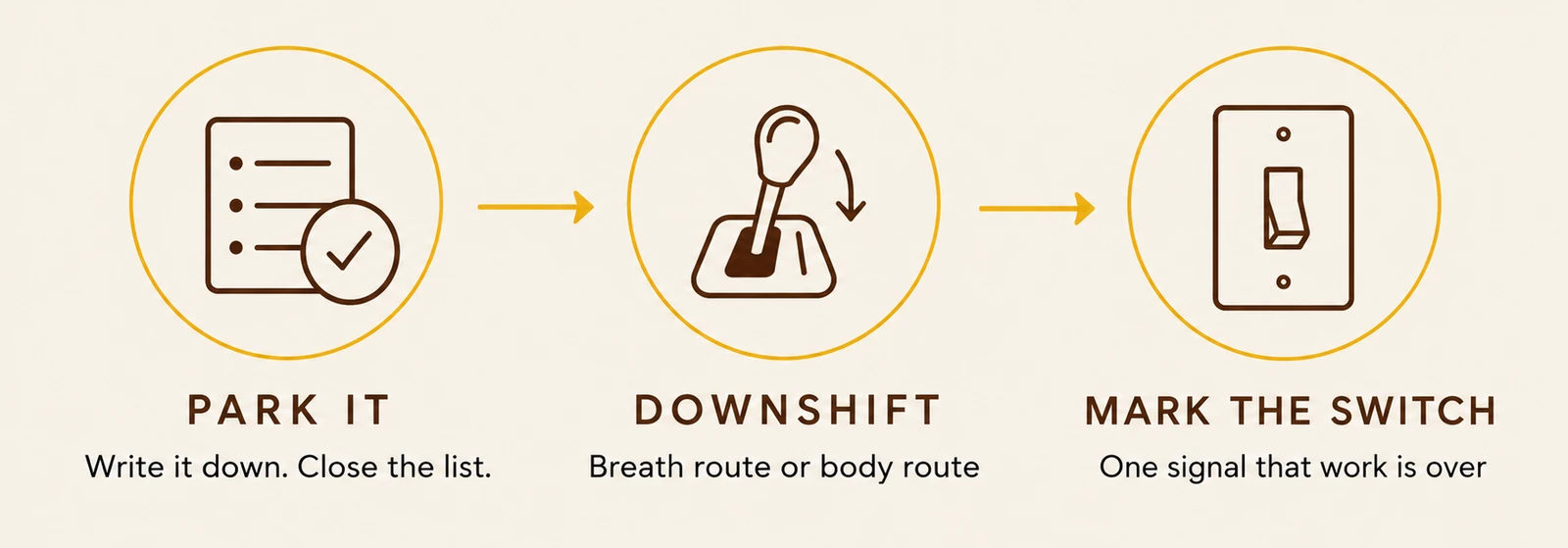
The three moves: Park it, write it down and close the list; Downshift, breath route or body route; Mark the switch, one signal that work is over.
  1. Park it.

    Write down what's still on your mind, with one next step for each. Then close the list. Unfinished things stop circling when they have somewhere to go.

  2. Downshift.

    Pick the route that suits you.

    • Breath route: one slow breath, or a short set of long exhales, standing or walking. No sitting still required.
    • Body route: shake out your hands and shoulders, take a brisk lap of the block or the stairs, or stand under warm water for sixty seconds.
  3. Mark the switch.

    Do one small thing that says "work is over": change into something you only wear at home, step outside for a minute, play the same song. Then say it out loud: "Work your name is off the clock."

Before and after, ask yourself one question: "How wired am I, 1 to 10?" There's no score to hit. Just notice.

A typical weekday: At 6:10, you shut the laptop. Instead of drifting to the couch, you spend two minutes parking tomorrow's worries on paper. You stand on the back step and let out three long breaths. You change your shirt. Same evening, different way into it.

A woman in a soft sweatshirt stands on her back step at dusk, looking out at a small garden, with warm kitchen light behind her.

What's inside

What you get

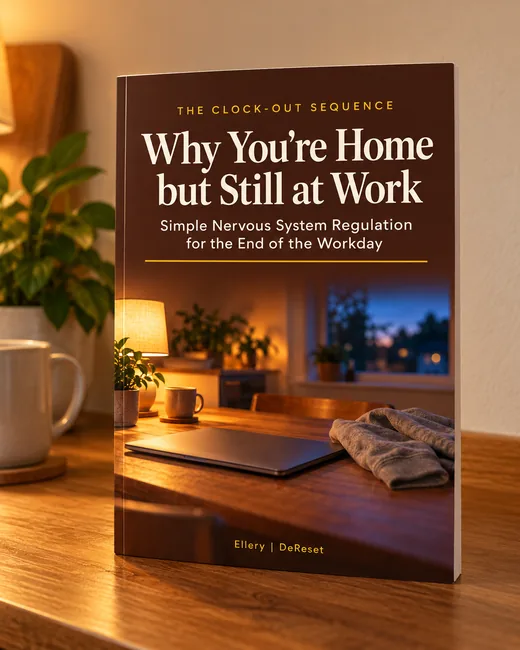
The guide Why You're Home but Still at Work, standing on a kitchen counter in lamp light.
The guide

Why You're Home but Still at Work

Why the workday doesn't end in your body, how the sequence works, how to set it up for your home, and what to do when it doesn't go to plan. Includes a 90-second version for bad days, plus versions for working from home, commuting, shift work, and busy households.

3 printable tools

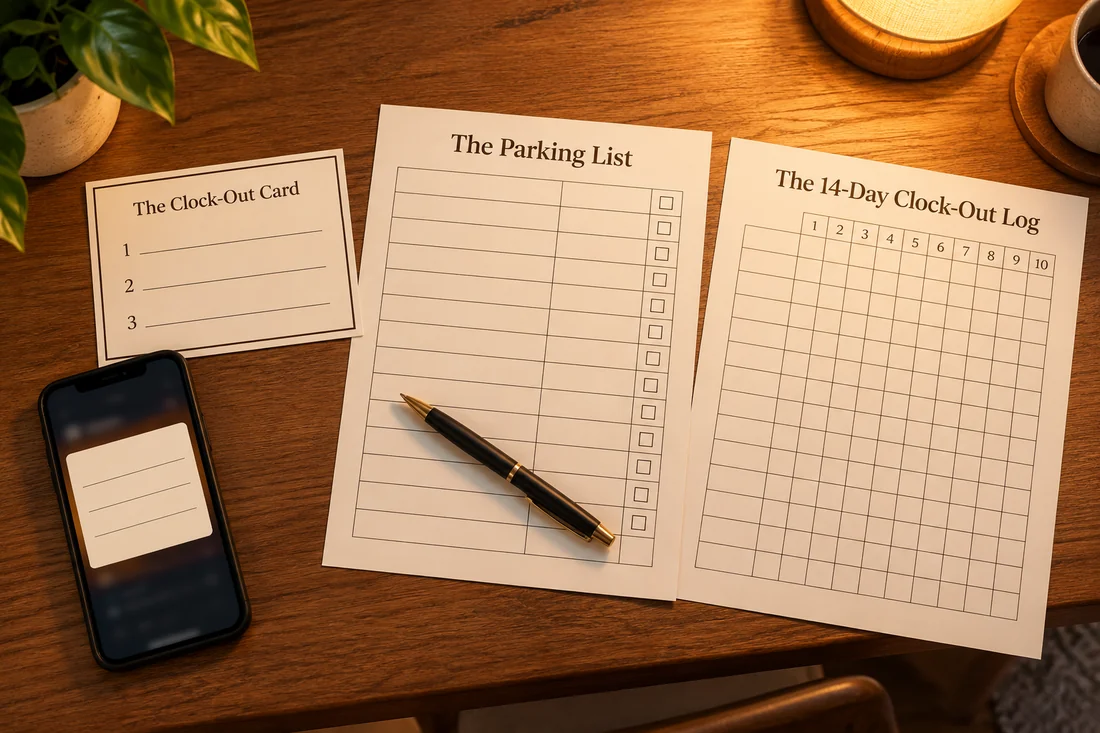
The Clock-Out Card

All three moves on one page, for the moment you need them. Printable, plus a version sized for your phone. It ends with your own line: "Work ______ is off the clock."

The Parking List

A reusable sheet for Move 1: what's still open, the next step, and a box to tick when it's parked.

The 14-Day Clock-Out Log

A one-page tracker for your first two weeks. Your before-and-after number, and which route you used, so you learn what works for you.

The Clock-Out Card, the Parking List and the 14-Day Clock-Out Log printed on a wooden table, with a pen and a phone showing the card.
The bonus guide The 10pm Drift, lying on a linen throw in lamp light.
Bonus · Included

The 10pm Drift

The second half of the evening. How to get from the couch to bed without losing two hours to your phone.

Why not just a cheap printable?

Most nervous system printables give you a list of exercises and leave you to pick. When you're wired at the end of a long day, choosing from sixty options is one more decision you don't have room for.

This is one routine, built for one moment: when your workday ends.

It works in a shared home, it takes minutes, it has a route that isn't breathing if breathing isn't your thing, and it has a 90-second version for nights when everything runs late.

Getting started

Your first 14 days

  1. Day 1Choose your cue, run the sequence once, and write down your before-and-after number.
  2. Days 2 to 7Repeat it at the same cue, and try both Downshift routes at least once.
  3. Days 8 to 14Keep the route that's working for you. On bad days, use the 90-second version.
  4. Day 14Look back at your Log and see which route works best for you.

Miss a day? That's expected. Just do the next one.

From the creator

Ellery, the creator of The Clock-Out Sequence, relaxing in an armchair at home in the evening.

From Ellery

By 6:15 most evenings, I was home. But I wasn't really home.

My body was on the couch. My head was still in the conference room, replaying a client call and drafting a sharper reply for tomorrow. My jaw ached. My shoulders were up by my ears.

For the next two hours I was off work, but not off. I made dinner on autopilot, snapped at my partner over nothing, then spent the rest of the night scrolling, wired and guilty.

I'd tried the apps. Sitting still and focusing on my breath just gave the noise in my head more room to get loud. A glass of wine took the edge off, but it took my mornings with it.

The turning point was a Tuesday. My daughter asked me to watch a movie with her, and I said, "In a minute." Two hours later the credits were rolling, and I'd missed all of it. I'd been sitting right there. I just wasn't there.

That night I didn't try to meditate. I went into the bathroom and took a hot shower. But instead of rushing, I stood there for sixty seconds and let the water hit the back of my neck. Then I put on a soft shirt I only ever wear at home, took one slow breath, and told myself, "Work Ellery is off the clock."

It sounds small. Maybe a little ridiculous. But that tiny, physical ritual gave my brain something it had been missing: a clear end to the workday.

That was two weeks ago. It hasn't fixed everything. But so far, it's given me my evenings back. And the next time my daughter asked about a movie? We watched the whole thing together.

This guide is that ritual, built out so it works on any evening, including the ones when a shower isn't an option. There's one step to get the workday out of your head, one to bring your body down, and one to mark the end.

Who it's for

It's for you if:

  • Your workday ends, but your mind and body don't seem to get the message.
  • You "relax" with your phone or the TV and still feel keyed up at bedtime.
  • You want something short and practical, not another long practice to fit in.

It's not for you if:

  • You're dealing with panic attacks, ongoing anxiety, trauma, or sleep problems that need treatment. Please talk to a doctor or a licensed professional. This guide doesn't replace that care.
  • You're in crisis or having thoughts of harming yourself. In the US, call or text 988 to reach the 988 Suicide & Crisis Lifeline, any time.

Your order

The offer

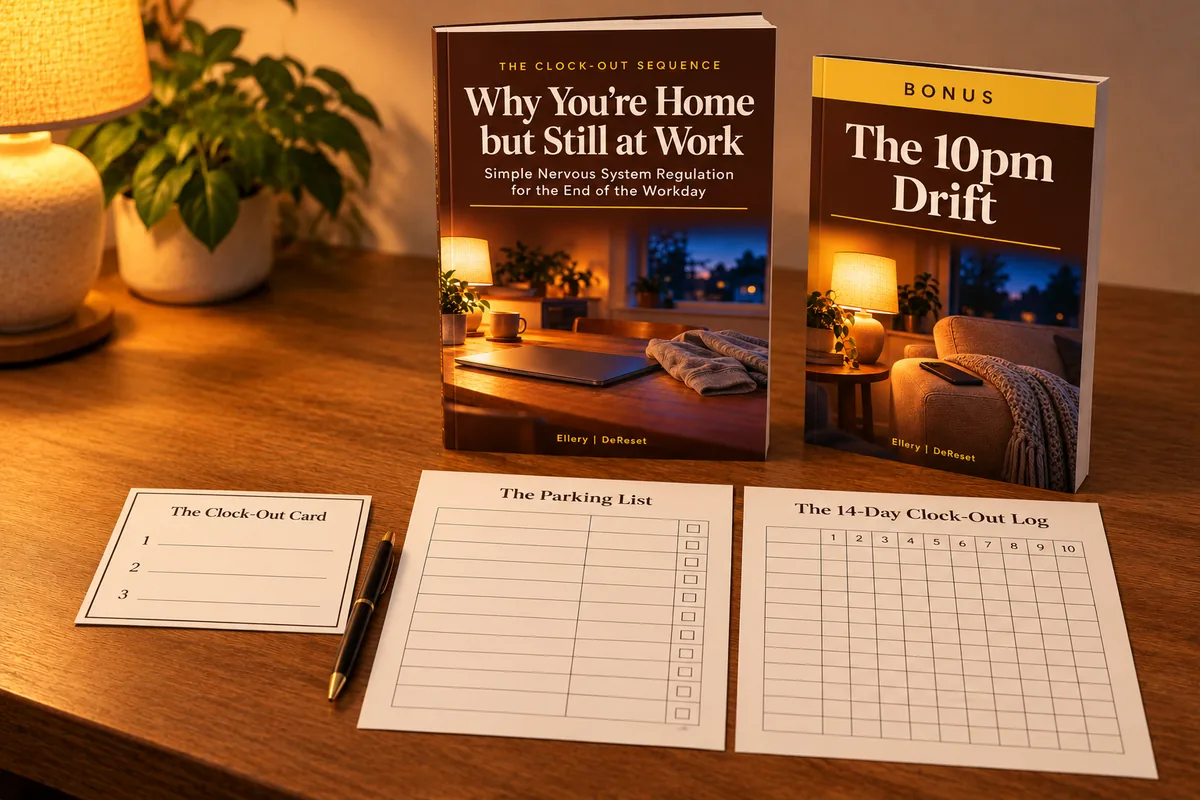
The guide, the bonus The 10pm Drift and the three printable tools together on a wooden table.
  • The guide: Why You're Home but Still at Work ($27 value)
  • The Clock-Out Card, printable and phone versions ($8 value)
  • The Parking List ($6 value)
  • The 14-Day Clock-Out Log ($6 value)
  • Bonus: The 10pm Drift ($17 value)

Total value: $64. Everything for $27.

Get The Clock-Out Sequence ($27)
30-day money-back guarantee seal.

Guarantee

Try The Clock-Out Sequence for 30 days. If it doesn't help, email me at [email protected] within 30 days and I'll refund every cent. No hoops.

Use it for your first 14 days. You still have the full 30 days to ask for a refund.

Questions

Is this therapy or treatment for anxiety?

No. It's a practical routine for everyday work stress: the kind where you're fine all day and can't come down at the end of it. It doesn't diagnose or treat anything. If you're dealing with anxiety, panic or something heavier, please see a doctor or licensed professional. You can use this alongside their care.

Breathing exercises don't work for me. Will this?

You don't have to use them. The Downshift step has a body route: movement, shaking it out, or warm water. If any practice feels uncomfortable, stop and use the other route.

I don't have time.

The full sequence takes about five to seven minutes. On bad days, there's a 90-second version.

I share my home with a partner, kids or roommates.

It's built for that. Nothing needs silence, a mat or a closed door. Several of the moves can be done with other people around.

I work from home. There's no "walking in the door."

Your cue becomes closing the laptop and standing up. The guide has a version for exactly this.

I work shifts or odd hours.

Use it whenever your workday ends. Nothing in it depends on the time on the clock.

Will this help me sleep?

It's not a sleep program, and it doesn't promise better sleep. It's about ending the workday. The bonus covers the stretch between the couch and bed.

What do I get, and how?

Instant download right after purchase. The guide and bonus are digital files you can read on any device. The three tools are printable, and the Card also comes in a phone-sized version.

What if it's not for me?

You're covered by the 30-day money-back guarantee above. No hoops.

Tonight, your workday will end at some point. The question is whether you'll actually leave it.

This time, you'll have a way to clock out: park it, downshift, mark the switch.

Get The Clock-Out Sequence ($27)

30‑day money‑back guarantee